


What is the difference between VAT on debits and VAT on collections?
The difference is essential to understand what Tempolia must send to the Approved Platform.
| VAT due mode | PA consequence |
|---|---|
| VAT on debits | VAT is declared without waiting for payment. Tempolia sends the electronic invoice or e-reporting transaction depending on client type, but the payment received later does not by itself create a PA payment declaration. |
| VAT on collections | VAT becomes due when payment is actually collected. Tempolia must transmit collection data, broken down by VAT rate, in addition to the invoice or transaction flow. |
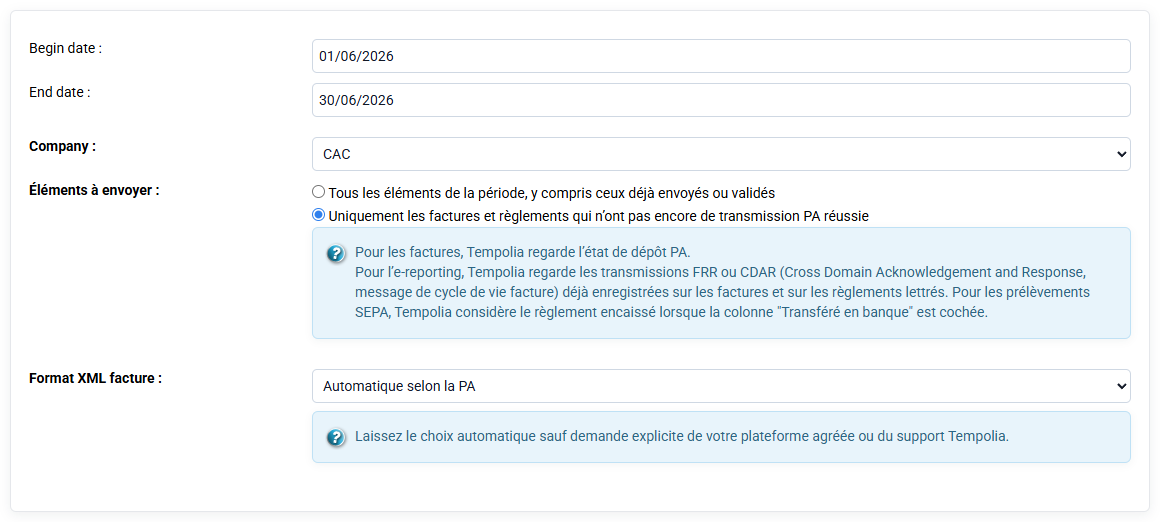
Payment remains useful for client follow-up, matching, reminders and accounting, even when it is not tax collection data to be transmitted to the PA. For a B2B France invoice handled through e-invoicing, collection is transmitted as an invoice lifecycle status. These statuses use CDAR format, Cross Domain Acknowledgement and Response, the standardized AFNOR base message for invoice lifecycle events. For a B2C or international invoice under e-reporting, collection is transmitted in a payment flow.
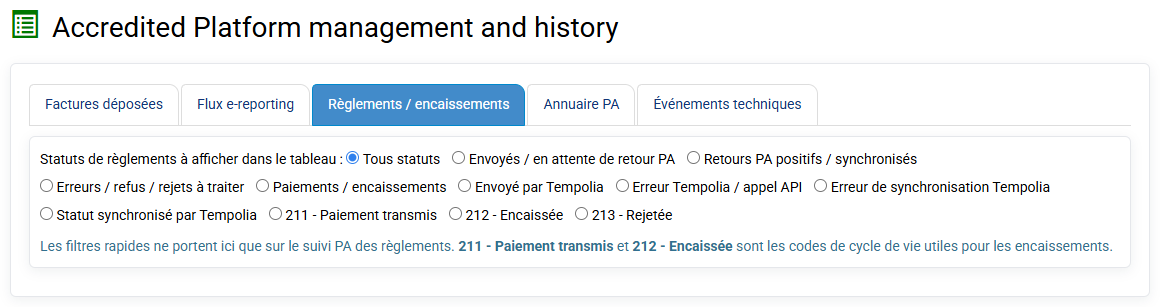
If an invoice contains mixed items, for example one part taxable on debits and another taxable on collection, only the lines or amounts subject to VAT on collections must feed PA payment data.
In practice, the user must therefore check the VAT regime applicable to the file, service and client before interpreting payment flows. For this reason, the notion of declared collection in Tempolia is always read after this VAT qualification. Tempolia must declare to the PA only a collection considered effective in Tempolia, and only for operations whose VAT is due on collection.
If the invoice is subject to VAT on debits, the payment remains useful for client follow-up and matching, but it does not by itself create a PA payment declaration. A scheduled payment is not a collection. A merely matched payment indicates accounting consistency, but it must also comply with Tempolia business rules to enter a PA flow. The date used to declare the payment remains the payment due date.
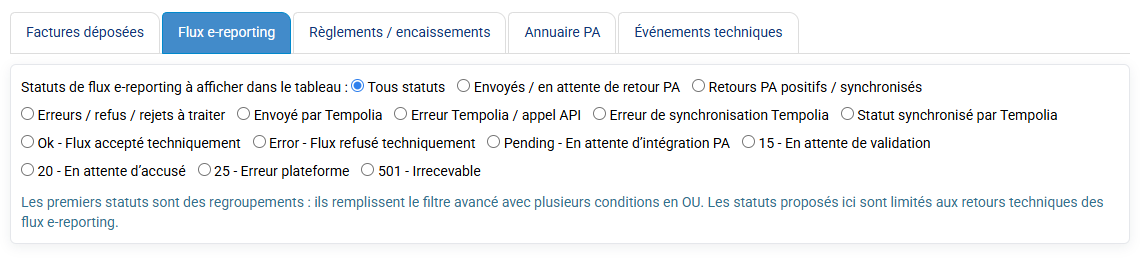
For a bank transfer, cheque or manual payment, the matched payment present in the period may feed the PA declaration. For a SEPA direct debit, Tempolia additionally requires the payment to be marked Transferred to bank. This rule avoids declaring a direct debit that has merely been prepared but not yet sent to the bank.
If the direct debit is rejected, the reject is managed by creating another negative payment with its own due date, see the FAQ "How do I manage a direct debit reject?". This negative payment must be matched like the other entries linked to the invoice. It will then be visible in the history and may correct the amount declared for the relevant period.